
How to Calculate Dog Years: Chart by Size and Formula
Is one dog year really seven human years? Not even close. If you’ve ever wondered how to calculate dog years, the old “multiply by seven” rule is the first thing to throw out. Dogs age fast early on, then slow down, and the pace depends on their size.
Below you’ll find a simple dog age chart by size, a newer formula you can use on any phone calculator, and a quick guide to what your dog’s age means for their care.
Dog years to human years chart (quick answer)
Here is a widely used estimate of a dog’s age in human years. Find your dog’s age in the first column, then read across to their size.
| Dog’s age | Small (under 20 lb) | Medium (21 to 50 lb) | Large (51 to 90 lb) | Giant (over 90 lb) |
|---|---|---|---|---|
| 1 year | 15 | 15 | 15 | 12 |
| 2 years | 24 | 24 | 24 | 22 |
| 3 years | 28 | 28 | 28 | 31 |
| 4 years | 32 | 32 | 32 | 38 |
| 5 years | 36 | 36 | 36 | 45 |
| 6 years | 40 | 42 | 45 | 49 |
| 7 years | 44 | 47 | 50 | 56 |
| 8 years | 48 | 51 | 55 | 64 |
| 9 years | 52 | 56 | 61 | 71 |
| 10 years | 56 | 60 | 66 | 79 |
| 11 years | 60 | 65 | 72 | 86 |
| 12 years | 64 | 69 | 77 | 93 |
| 13 years | 68 | 74 | 82 | 100 |
| 14 years | 72 | 78 | 88 | 107 |
| 15 years | 76 | 83 | 93 | 114 |
Treat this as a rough guide, not an exact answer. Different sources use slightly different numbers, and no chart can account for your dog’s breed, health and lifestyle. If your dog is a mix, go by the size they are now.
Why the “1 dog year = 7 human years” rule is wrong
The seven-year rule is a handy shortcut, but it doesn’t hold up. A 1-year-old dog is not a 7-year-old child. By their first birthday most dogs have reached adult size and maturity, which looks a lot more like a teenager or young adult.
The chart above shows it. The first year counts for about 15 human years, the second adds roughly 9 more, and after that each year adds about 4 to 5 for a medium dog. Bigger dogs speed up faster later on, which is why a 10-year-old giant breed is far older than a 10-year-old Chihuahua.
How many dog years are in 1 human year?
It depends on your dog’s age and size, so there is no single number. For a medium dog, the first calendar year is worth about 15 human years, the second about 9, and every year after that about 4 to 5. For giant breeds, the later years count for even more.
How to calculate dog years (the newer formula)
Researchers at the University of California San Diego looked at the DNA changes that happen as dogs and people age. They studied 104 Labrador Retrievers and compared the results with human data. The outcome was a formula that is far more realistic than multiplying by seven:
Human age = 16 × ln(dog’s age) + 31
“ln” is the natural log button on a calculator. You don’t need to know any math to use it.
Dog years calculator: do it yourself in 3 steps
- Type your dog’s age in years on a calculator. On a phone, turn it sideways to see the “ln” button.
- Press ln, then multiply the result by 16.
- Add 31. That’s your dog’s age in human years.
Take a 7-year-old dog. ln(7) is about 1.95. Multiply by 16 and you get about 31, then add 31 for roughly 62 human years.
Here are a few results from the formula:
| Dog’s age | Human years (formula) |
|---|---|
| 1 | 31 |
| 2 | 42 |
| 4 | 53 |
| 7 | 62 |
| 9 | 66 |
| 10 | 68 |
| 12 | 71 |
| 15 | 74 |
You’ll notice these numbers don’t match the chart, and that’s normal. The chart is a size-based estimate, while the formula was built from Labrador DNA, so think of it as a research-based guide. Neither one is the final word. What matters more than the number is how your dog is doing day to day.
How old is my dog in dog years?
Here are the questions people ask most.
How old is a 7-year-old dog in human years? About 44 for a small dog, 47 for medium, 50 for large and 56 for giant, using the chart. The formula gives about 62.
How old is a 10-year-old dog in human years? About 56 for a small dog, 60 for medium, 66 for large and 79 for giant, using the chart. The formula gives about 68.
How old is a 2-year-old dog in human years? Around 24 by the chart (22 for giant breeds) and about 42 by the formula.
Human years to dog years
Want to go the other way? Read the chart in reverse. Find the human age you’re after in the column for your dog’s size, then look left for the dog’s age. For example, 56 human years matches a 10-year-old small dog or a 9-year-old medium dog.
Keep in mind that this is only a fun comparison. A dog’s body and mind age differently from ours.
What your dog’s age means for care
Dog years are interesting, but the real reason to know your dog’s age is to give the right care at the right time. Dogs usually become seniors at about these ages:
| Dog size | Senior age (dog years) |
|---|---|
| Small | 9 to 12 years |
| Medium | 8 to 10 years |
| Large | 7 to 9 years |
| Giant | 6 to 7 years |
If your dog has reached this stage, it’s a good time to book a senior checkup and watch for early changes like stiffness, cloudy eyes or more sleep. We cover both in these guides: when a dog is considered a senior and 15 signs of aging in dogs.

FAQ
How do you calculate dog years?
The old rule says to multiply by seven, but that isn’t accurate. A better way is to use a chart by size, or the formula 16 × ln(dog’s age) + 31, which a UC San Diego research team developed from a study of Labrador Retrievers.
Is 1 human year really 7 dog years?
No. It’s a rough shortcut that doesn’t match how dogs age. Dogs age much faster in the first two years, and then at a rate that depends on their size.
How old is a 7-year-old dog in human years?
Between about 44 and 56, depending on size, if you use a size-based chart. The newer formula gives about 62 for a Lab-sized dog.
Do small dogs age slower than big dogs?
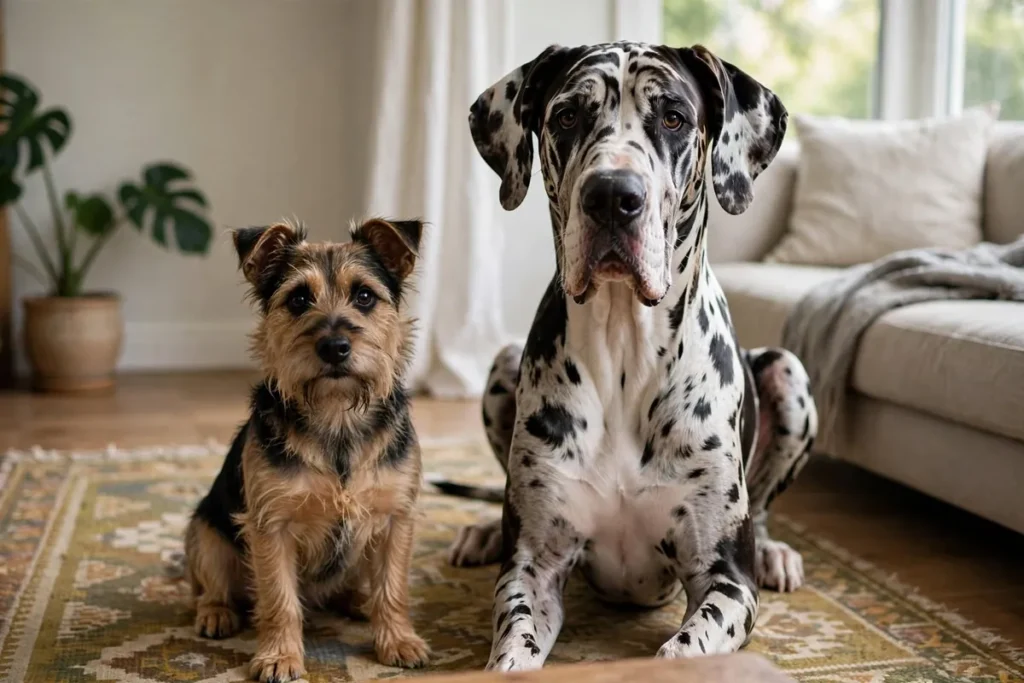
Yes, in general. Small dogs live longer on average and reach senior age later. Giant breeds age faster and are seniors as early as 6 or 7.
How old is my dog if I adopted a rescue and don’t know the age?
Your vet can estimate the age from their teeth, eyes, coat and body. It’s usually a rough range, such as “about 6 to 8 years,” rather than an exact number.
At what age is a dog a senior?
It depends on size, from about 6 to 7 years for giant breeds to 9 to 12 years for small dogs.
Final thoughts
Dog years to human years isn’t a perfect science. The chart gives you a quick answer by size, and the formula gives a research-based one. Use either as a guide, not a rule. What matters most is paying attention to how your dog is doing, keeping up with vet visits, and adjusting care as they get older.
Read next: 15 Signs of Aging in Dogs
This article is general information, not veterinary advice. Always ask your own veterinarian about your dog’s health.